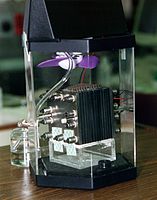
Photo from wikipedia
Abstract The high power performance of low-temperature polymer electrolyte fuel cells (PEFCs), rendering them an elevated spot among portable and transportation oriented energy conversion systems, depends primarily on the precise… Click to show full abstract
Abstract The high power performance of low-temperature polymer electrolyte fuel cells (PEFCs), rendering them an elevated spot among portable and transportation oriented energy conversion systems, depends primarily on the precise selection and utilization of materials for their membrane electrode assemblies (MEAs). Since 2010, the advent and use of 2D materials: graphene, hexagonal boron nitride (hBN), molybdenum di sulphide (MoS2) and tungsten di sulphide (WS2) in fabrications of MEAs have demonstrated their potentials to tremendously boost the power density of PEFCs, compared to conventional materials. Therefore, it becomes essential to summarize, analyze and provide insights into the role of 2D materials in PEFCs over the past decade. This review starts with a general introduction of low-temperature PEFCs and 2D materials, followed by insights into 2D crystallite usage in their different MEA layers (gas diffusion media, catalyst layers and membranes). Recent trends in synthesis methods, structure and property relationships of different 2D materials, their hetero atom doped counterparts, electrode and membrane morphologies, state of the art for MEA configurations, mechanism behind performance enhancements and scale-up limitations are critically analyzed. Constructive suggestions and futuristic outlook onto emerging fields of atomic engineered materials and their applicability in fuel cells are also discussed.
Journal Title: Chemical Engineering Journal
Year Published: 2021
Link to full text (if available)
Share on Social Media: Sign Up to like & get
recommendations!