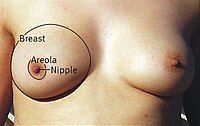
Photo from wikipedia
BACKGROUND Some evidence shows that aspirin can reduce the morbidity and mortality of different cancers, including breast cancer. Aspirin has become a new focus of cancer prevention and treatment research… Click to show full abstract
BACKGROUND Some evidence shows that aspirin can reduce the morbidity and mortality of different cancers, including breast cancer. Aspirin has become a new focus of cancer prevention and treatment research at present, however, clinical studies found conflicting conclusions of its anticancer characteristics. MATERIALS AND METHODS A systematic literature search was performed in 8 electronic databases. The pooled relative risk (RR) with 95% confidence interval (CI) was calculated using the random effects model to estimate the effect of aspirin on breast cancer. RESULTS Forty-two published articles with 99,769 patients were identified. The meta-analysis showed a significant decrease in breast cancer risk with aspirin use (RR, 0.92; 95% CI, 0.89-0.96; I2 = 72%). Aspirin use decreased the risk of hormone receptor-positive tumors (estrogen receptor [ER]-positive RR, 0.89; 95% CI, 0.82-0.97; I2=54%; progesterone receptor [PR]-positive RR, 0.86; 95% CI, 0.78-0.95; I2=32%; ER- and PR-positive RR, 0.92; 95% CI, 0.85-1.00; I2=45%) and reduced the risk of breast cancer in postmenopausal women (RR, 0.92; 95% CI, 0.86-0.98; I2=59%). Further analysis showed that for the in situ breast cancer, regular-dose and more than 3 years use of aspirin were associated with the reduced risk of breast cancer. CONCLUSION This meta-analysis suggested that aspirin may reduce the overall risk of breast cancer, reduce the risk of breast cancer in postmenopausal women, hormone receptor-positive tumors, and in situ breast cancer. Larger, multicenter clinical studies are needed to find the optimal dose range, frequency, and duration of the aspirin use to explore the best benefit-risk ratio.
Journal Title: Clinical breast cancer
Year Published: 2021
Link to full text (if available)
Share on Social Media: Sign Up to like & get
recommendations!