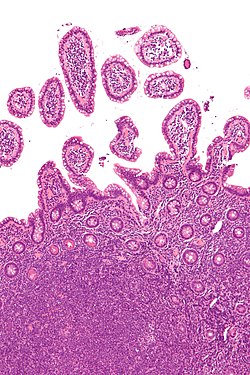
Photo from wikipedia
Decades of research into the molecular signalling determinants of B cell fates, and recent progress in characterising the genetic drivers of lymphoma, has led to a detailed understanding of B… Click to show full abstract
Decades of research into the molecular signalling determinants of B cell fates, and recent progress in characterising the genetic drivers of lymphoma, has led to a detailed understanding of B cell malignancies but also revealed daunting heterogeneity. While current therapies for diffuse large B-cell lymphoma are effective for some patients, they are largely agnostic to the biology of each individual’s disease, and approximately one third of patients experience relapsed/refractory disease. Consequently, the challenge is to understand how each patient’s mutational burden and tumour microenvironment combine to determine their response to treatment; overcoming this challenge will improve outcomes in lymphoma. This mini review highlights how data-driven modelling, statistical approaches and machine learning are being used to unravel the heterogeneity of lymphoma. We review how mechanistic computational models provide a framework to embed patient data within knowledge of signalling. Focusing on recurrently dysregulated signalling networks in lymphoma (including NF-κB, apoptosis and the cell cycle), we discuss the application of state-of-the-art mechanistic models to lymphoma. We review recent advances in which computational models have demonstrated the power to predict prognosis, identify promising combination therapies and develop digital twins that can recapitulate clinical trial results. With the future of treatment for lymphoma poised to transition from one-size-fits-all towards personalised therapies, computational models are well-placed to identify the right treatments to the right patients, improving outcomes for all lymphoma patients.
Journal Title: Biochemical Society Transactions
Year Published: 2025
Link to full text (if available)
Share on Social Media: Sign Up to like & get
recommendations!