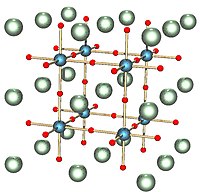
Photo from wikipedia
Multi-dimensional perovskite (MDP) interface consisting of a lower-dimensional (2D) perovskite phase sandwiched between a bulk (3D) perovskite layer and a charge transporting layer is being propounded as a feasible solution… Click to show full abstract
Multi-dimensional perovskite (MDP) interface consisting of a lower-dimensional (2D) perovskite phase sandwiched between a bulk (3D) perovskite layer and a charge transporting layer is being propounded as a feasible solution for enhancing the stability of perovskite solar cells (PSCs). Here, using first principles-based density functional theory calculations, we study the effect of interface anion engineering on the stability and electronic property of the MDP interfaces. We find that 2D–3D perovskite interfaces are highly stable and are immune to interfacial defect formation. Furthermore, interface chlorination helps in mitigating the deleterious effect of charge localization for antisite defects at these interfaces. For an interface between 2D-perovskite and a charge-extracting TiO2 layer, we find that interfacial anion engineering is instrumental in alleviating the lattice mismatch induced instability. We propose that opposed to interfacial defects, the hole localization arising due to the presence of interfacial halide at the pristine 2D-TiO2 interface is the major obstacle that needs to be overcome for achieving a defect immune MDP for realizing a PSC with ultrahigh stability and performance.
Journal Title: Applied Physics Letters
Year Published: 2021
Link to full text (if available)
Share on Social Media: Sign Up to like & get
recommendations!