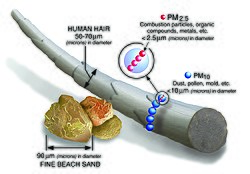
Photo from wikipedia
Abstract. Aerosol–cloud–precipitation interaction is currently a research hotspot that is challenging but also one of the most prominent sources of uncertainty affecting climate change. We have identified 1082 mesoscale convective… Click to show full abstract
Abstract. Aerosol–cloud–precipitation interaction is currently a research hotspot that is challenging but also one of the most prominent sources of uncertainty affecting climate change. We have identified 1082 mesoscale convective systems (MCSs) over eastern China from April to September in 2016 and 2017. Overall, the occurrence frequency and MCS area increased when altitude increased, as demonstrated by the t-test at 95% confidence. More MCSs appeared and matured fully, although they moved slowly, in a selected urban agglomeration area compared to a selected rural area, owing to the urbanization impact. With an increase in the concentration of particulate matter with particle size below 10 μm (PM10) averaged by the first 3 h of MCS initiations, the cloud top brightness temperature and MCS area decreased, resulting in weakened precipitation intensity and a smaller MCS area. The t-test was passed with 90% confidence, confirming this finding. In addition, high-humidity circumstances can produce enough water vapor to support the creation of many higher and deeper MCSs.
Journal Title: Journal of Applied Remote Sensing
Year Published: 2024
Link to full text (if available)
Share on Social Media: Sign Up to like & get
recommendations!