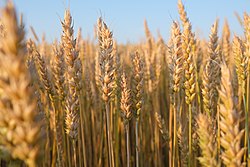
Photo from wikipedia
The Alternaria fungus represents a significant threat to grain storage safety due to its production of mycotoxins, which pose serious risks to human health. This study explores the toxin profile… Click to show full abstract
The Alternaria fungus represents a significant threat to grain storage safety due to its production of mycotoxins, which pose serious risks to human health. This study explores the toxin profile of 153 stored wheat samples collected from five distinct regions in Xizang , analyzed by ultrahigh-performance liquid chromatography-tandem mass spectrometry (UPLC-MS/MS). Our findings reveal that tenuazonic acid (TeA) is the predominant toxin detected in wheat (Triticum aestivum L.), with toxin levels exhibiting a significant negative correlation to altitude. To elucidate the molecular mechanisms underlying the differential toxigenic profiles of Alternaria alternata strains from various altitudes, integration of metabolomic and transcriptomic analyses was performed. Alternaria strains were categorized based on their toxin-producing capacity as high toxin-producing (HT), medium toxin-producing (MT), and low toxin-producing (LT) strains. The data indicate that altitude influences the activity of amino acid and carbohydrate metabolism, both of which are critical to the biosynthesis of Alternaria toxins. Co-expression analysis identified nine candidate structural genes and four key transcription factors that regulate the toxin biosynthesis pathway. Notably, the PacC transcription factor emerged as a central regulator of toxin production in response to altitude. Functional validation using a PacC knockout mutant confirmed a reduction in toxin production, along with downregulation of the associated biosynthetic genes, particularly those involved in TeA synthesis. This integrated approach provides new insights into the molecular and metabolic mechanisms driving the variation in toxin production, offering potential targets for mitigating mycotoxin contamination in stored grain.
Journal Title: BMC Microbiology
Year Published: 2025
Link to full text (if available)
Share on Social Media: Sign Up to like & get
recommendations!