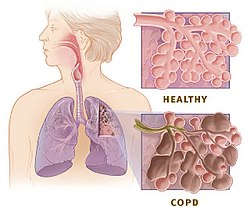
Photo from wikipedia
Background/Objectives: Chronic obstructive pulmonary disease (COPD) and type 2 diabetes mellitus (T2DM) frequently coexist, contributing to worse clinical outcomes and increased risk of exacerbations. While newer glucose-lowering agents have demonstrated… Click to show full abstract
Background/Objectives: Chronic obstructive pulmonary disease (COPD) and type 2 diabetes mellitus (T2DM) frequently coexist, contributing to worse clinical outcomes and increased risk of exacerbations. While newer glucose-lowering agents have demonstrated cardiovascular and renal benefits, their comparative efficacy on COPD exacerbations remain uncertain. Methods: We systematically searched PubMed, Embase, Web of Science, Cochrane Library, and ClinicalTrials.gov from inception to June 2025. We included randomised controlled trials (RCTs) and observational studies enrolling adults with COPD and T2DM that reported the risk of COPD exacerbations following initiation of SGLT2is, GLP-1RAs, DPP-4is, or sulfonylureas, with an active comparator group. The primary outcome was a composite of moderate-to-severe COPD exacerbations. Secondary outcomes included the individual components separately. A Bayesian random-effects network meta-analysis was performed to estimate risk ratio (RR) with 95% credible intervals (95% CIs). Results: Nine observational studies were ultimately included. No RCTs were retrieved. Compared to sulfonylureas, initiation of SGLT2is (RR 0.64, 0.59–0.69), GLP-1RAs (0.66, 0.60–0.71), and DPP-4is (0.79, 0.74–0.86) was associated with reduced risk of moderate-to-severe exacerbations. Moreover, SGLT2is (0.80, 0.75–0.86) and GLP-1RAs (0.83, 0.77–0.88) were more favourable compared to DPP4is. Consistent results were found for secondary outcomes. Sensitivity analyses confirmed the robustness of the findings for the primary outcome. Robustness was not consistently observed across all treatment comparisons for secondary outcomes. Conclusions: Among patients with COPD and T2DM, newer glucose-lowering agents, particularly SGLT2is and GLP-1RAs, were associated with significantly lower risk of moderate-to-severe exacerbations. These findings support the potential respiratory benefits of these agents and warrant confirmation through RCTs.
Journal Title: Pharmaceuticals
Year Published: 2025
Link to full text (if available)
Share on Social Media: Sign Up to like & get
recommendations!