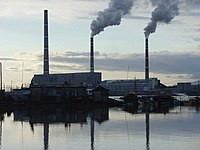
Photo from wikipedia
Many organisations consider environmentally friendly activities, including the reduction of their carbon footprint, to be a significant aspect of their operation. In this study, a mathematical model was used to… Click to show full abstract
Many organisations consider environmentally friendly activities, including the reduction of their carbon footprint, to be a significant aspect of their operation. In this study, a mathematical model was used to calculate the carbon footprint of food products at different stages of internal transport, using data on internal transport energy consumption. It was shown that for most products, the highest carbon footprint was related to the raw material transport stage from the loading/unloading point to the workstations on the production line. Broccoli showed the highest carbon footprint for internal transport per tonne of raw material. The study proposes methods of reducing the internal transport-related carbon footprint, which involves reorganising the distribution of goods in the warehouse and using nutritionally valuable vegetable waste in the production of food products.
Journal Title: Sustainability
Year Published: 2021
Link to full text (if available)
Share on Social Media: Sign Up to like & get
recommendations!