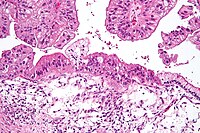
Photo from wikipedia
Nerves have been widely demonstrated to exert major effects in tumor-associated microenvironments. Due to the characteristic innervation of the oral cavity and the fact that cancer-associated pain is a distinct… Click to show full abstract
Nerves have been widely demonstrated to exert major effects in tumor-associated microenvironments. Due to the characteristic innervation of the oral cavity and the fact that cancer-associated pain is a distinct feature of oral squamous cell carcinoma (OSCC), the sensory nerves may dominate in the OSCC-nerve microenvironment. As the most abundant neuropeptide in the trigeminal ganglion, the calcitonin gene-related peptide (CGRP) exerts a dual effect on cancer development and cancer-associated pain in various types of cancer. The present review explored the potential molecular mechanisms of the roles of CGRP in cancer development and cancer-associated pain, suggesting that CGRP may be a promising therapeutic target for OSCC.
Journal Title: Oncology Letters
Year Published: 2020
Link to full text (if available)
Share on Social Media: Sign Up to like & get
recommendations!