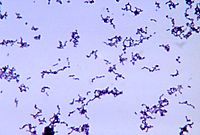
While home chlorhexidine washes prior to shoulder surgery lower skin loads of most bacteria, they are not effective against Cutibacterium (Propionibacterium)
Sign Up to like & getrecommendations! Published in 2020 at "International Orthopaedics"
DOI: 10.1007/s00264-019-04477-w
Abstract: Chlorhexidine showers prior to shoulder arthroplasty are commonly recommended by surgeons to lower the risk of periprosthetic infection; however, the effectiveness of these washes in eliminating bacteria from the skin of the shoulder has not… read more here.
Keywords: surgery; skin; shoulder; chlorhexidine ... See more keywords

Culturing Explants for Cutibacterium at Revision Shoulder Arthroplasty: An Analysis of Explant and Tissue Samples at Corresponding Anatomic Sites.
Sign Up to like & getrecommendations! Published in 2022 at "Journal of shoulder and elbow surgery"
DOI: 10.1016/j.jse.2022.03.004
Abstract: BACKGROUND Culturing of deep tissues obtained at revision arthroplasty for Cutibacterium is a key component of diagnosing a periprosthetic infection. The value of culturing explanted components has not been well-described. This study sought to answer… read more here.
Keywords: cutibacterium; shoulder; revision; tissue ... See more keywords
Interaction of Cutibacterium ( formerly Propionibacterium) acnes with bone cells: a step toward understanding bone and joint infection development
Sign Up to like & getrecommendations! Published in 2017 at "Scientific Reports"
DOI: 10.1038/srep42918
Abstract: Cutibacterium acnes (formerly Propionibacterium acnes) is recognized as a pathogen in foreign-body infections (arthroplasty or spinal instrumentation). To date, the direct impact of C. acnes on bone cells has never been explored. The clade of… read more here.
Keywords: propionibacterium acnes; bone cells; bone; acnes bone ... See more keywords
Sarecycline inhibits protein translation in Cutibacterium acnes 70S ribosome using a two-site mechanism
Sign Up to like & getrecommendations! Published in 2023 at "Nucleic Acids Research"
DOI: 10.1093/nar/gkad103
Abstract: Abstract Acne vulgaris is a chronic disfiguring skin disease affecting ∼1 billion people worldwide, often having persistent negative effects on physical and mental health. The Gram-positive anaerobe, Cutibacterium acnes is implicated in acne pathogenesis and… read more here.
Keywords: inhibits protein; sarecycline inhibits; 70s ribosome; cutibacterium acnes ... See more keywords

Cutibacterium acnes: Much ado about maybe nothing much
Sign Up to like & getrecommendations! Published in 2021 at "Experimental Dermatology"
DOI: 10.1111/exd.14394
Abstract: Cutibacterium acnes (also known as Propionibacterium acnes) has long been implicated in the pathogenesis of acne, inspiring both therapeutic and personal care approaches aiming to control the disease by controlling the bacterium. The purported association… read more here.
Keywords: acnes much; ado maybe; cutibacterium acnes; maybe nothing ... See more keywords

Characterisation of Cutibacterium acnes phylotypes in acne and in vivo exploratory evaluation of Myrtacine®
Sign Up to like & getrecommendations! Published in 2018 at "Journal of the European Academy of Dermatology and Venereology"
DOI: 10.1111/jdv.15042
Abstract: Our main objective was to compare Cutibacterium acnes (C. acnes) skin colonisation in patients with mild to moderate acne versus healthy controls and secondly, to evaluate a Myrtacine®‐based cream on C. acnes total population and… read more here.
Keywords: phylotypes acne; acnes phylotypes; characterisation cutibacterium; cutibacterium acnes ... See more keywords
Myrtus communis and Celastrol enriched plant cell culture extracts control together the pivotal role of Cutibacterium acnes and inflammatory pathways in acne
Sign Up to like & getrecommendations! Published in 2023 at "Journal of the European Academy of Dermatology and Venereology"
DOI: 10.1111/jdv.18793
Abstract: Acne is a multifactorial inflammatory disease of the pilosebaceous unit in which Cutibacterium acnes is one of the main triggers. A strong predominance of C. acnes phylotype IA1 is present in acne skin with higher… read more here.
Keywords: celastrol enriched; myrtus communis; cutibacterium acnes; cutibacterium ... See more keywords
Ribotype‐dependent growth inhibition and promotion by erythritol in Cutibacterium acnes
Sign Up to like & getrecommendations! Published in 2022 at "Journal of Cosmetic Dermatology"
DOI: 10.1111/jocd.14958
Abstract: The close balance between Cutibacterium acnes and the skin flora, particularly between C. acnes phylotypes, has been suggested to play an important role in the onset of acne. C. acnes has been classified into ribotypes… read more here.
Keywords: inhibition promotion; dependent growth; cutibacterium acnes; growth inhibition ... See more keywords
Microbial diagnostic features identified across populations possess potential antitumor properties in breast cancer
Sign Up to like & getrecommendations! Published in 2025 at "mSystems"
DOI: 10.1128/msystems.00271-25
Abstract: ABSTRACT The consistency of the associations between the breast microbiome and breast cancer (BC) across various studies remains uncertain. Publicly accessible data sets from five BC studies, comprising 16S rRNA gene sequencing data from 161… read more here.
Keywords: cancer; breast cancer; breast; cutibacterium ... See more keywords
Integrated analysis of microbiome and metabolome reveals signatures in PDAC tumorigenesis and prognosis
Sign Up to like & getrecommendations! Published in 2024 at "Microbiology Spectrum"
DOI: 10.1128/spectrum.00962-24
Abstract: ABSTRACT Pancreatic cancer, predominantly pancreatic ductal adenocarcinoma (PDAC), is one of the most malignant tumors of the digestive system. Emerging evidence suggests the involvement of the microbiome and metabolic substances in the development of PDAC,… read more here.
Keywords: adenocarcinoma; microbiome; cutibacterium; analysis ... See more keywords
A case report of native vertebral osteomyelitis caused by Cutibacterium modestum
Sign Up to like & getrecommendations! Published in 2022 at "BMC Infectious Diseases"
DOI: 10.1186/s12879-022-07341-2
Abstract: Background Cutibacterium modestum was named in 2020. C. modestum was previously called Propionibacterium humerusii . Several implant-associated infections caused by Cutibacterium species have been previously reported, but native vertebral osteomyelitis due to these bacteria has… read more here.
Keywords: cutibacterium; vertebral osteomyelitis; case; osteomyelitis caused ... See more keywords