Graph Edge Coloring: A Survey
Sign Up to like & getrecommendations! Published in 2019 at "Graphs and Combinatorics"
DOI: 10.1007/s00373-018-1986-5
Abstract: Graph edge coloring has a rich theory, many applications and beautiful conjectures, and it is studied not only by mathematicians, but also by computer scientists. In this survey, written for the non-expert, we shall describe… read more here.
Keywords: graph edge; edge coloring; coloring survey;

A Structure of 1-Planar Graph and Its Applications to Coloring Problems
Sign Up to like & getrecommendations! Published in 2019 at "Graphs and Combinatorics"
DOI: 10.1007/s00373-019-02027-0
Abstract: A graph is 1-planar if it can be drawn on a plane so that each edge is crossed by at most one other edge. In this paper, we first give a useful structural theorem for… read more here.
Keywords: list; graph; edge coloring; planar graph ... See more keywords
Magic Labeling of Disjoint Union Graphs
Sign Up to like & getrecommendations! Published in 2019 at "Acta Mathematica Sinica, English Series"
DOI: 10.1007/s10114-019-8500-8
Abstract: Let G be a graph with vertex set V(G), edge set E(G) and maximum degree Δ respectively. G is called degree-magic if it admits a labelling of the edges by integers {1, 2, …, |E(G)|}… read more here.
Keywords: labeling disjoint; edge; graph; edge coloring ... See more keywords
An exact algorithm for the edge coloring by total labeling problem
Sign Up to like & getrecommendations! Published in 2020 at "Annals of Operations Research"
DOI: 10.1007/s10479-018-2977-x
Abstract: This paper addresses the edge coloring by total labeling graph problem. This is a labeling of the vertices and edges of a graph such that the weights (colors) of the edges, defined by the sum… read more here.
Keywords: problem; coloring total; algorithm; edge coloring ... See more keywords

Anti-Ramsey coloring for matchings in complete bipartite graphs
Sign Up to like & getrecommendations! Published in 2017 at "Journal of Combinatorial Optimization"
DOI: 10.1007/s10878-015-9926-2
Abstract: The anti-Ramsey number AR(G, H) is defined to be the maximum number of colors in an edge coloring of G which doesn’t contain any rainbow subgraphs isomorphic to H. It is clear that there is an… read more here.
Keywords: ramsey coloring; anti ramsey; anti; edge coloring ... See more keywords
Adjacent Vertex Distinguishing Edge Coloring of Planar Graphs Without 4-Cycles
Sign Up to like & getrecommendations! Published in 2019 at "Bulletin of the Malaysian Mathematical Sciences Society"
DOI: 10.1007/s40840-019-00860-3
Abstract: The adjacent vertex distinguishing edge coloring of a graph G is a proper edge coloring of G such that the edge coloring set on any pair of adjacent vertices is distinct. The minimum number of… read more here.
Keywords: vertex distinguishing; adjacent vertex; edge; edge coloring ... See more keywords
Edge-Coloring Technique to Analyze Elementary Trapping Sets of Spatially-Coupled LDPC Convolutional Codes
Sign Up to like & getrecommendations! Published in 2020 at "IEEE Communications Letters"
DOI: 10.1109/lcomm.2019.2962671
Abstract: In this letter, for the first time, an edge-coloring technique is proposed to characterize a certain elementary trapping set (ETS) and to obtain sufficient conditions to avoid small ETSs from occurrence in the Tanner graph… read more here.
Keywords: coloring technique; convolutional codes; ldpc convolutional; elementary trapping ... See more keywords
Fuzzy Edge Chromatic Number of the Join of Fuzzy Graphs and Its Applications
Sign Up to like & getrecommendations! Published in 2025 at "Axioms"
DOI: 10.3390/axioms14110822
Abstract: Fuzzy edge coloring has proven to be a powerful tool for modeling and optimizing complex network systems, owing to its ability to effectively represent and manage the uncertainty in relational strengths and conflicts. It focuses… read more here.
Keywords: edge coloring; edge; fuzzy edge; edge chromatic ... See more keywords
Facial rainbow edge-coloring of simple 3-connected plane graphs
Sign Up to like & getrecommendations! Published in 2020 at "Opuscula Mathematica"
DOI: 10.7494/opmath.2020.40.4.475
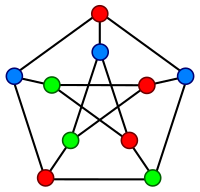
Abstract: A facial rainbow edge-coloring of a plane graph \(G\) is an edge-coloring such that any two edges receive distinct colors if they lie on a common facial path of \(G\). The minimum number of colors… read more here.
Keywords: rainbow edge; edge coloring; facial rainbow; text ... See more keywords
Facial graceful coloring of plane graphs
Sign Up to like & getrecommendations! Published in 2024 at "Opuscula Mathematica"
DOI: 10.7494/opmath.2024.44.6.815
Abstract: Let \(G\) be a plane graph. Two edges of \(G\) are facially adjacent if they are consecutive on the boundary walk of a face of \(G\). A facial edge coloring of \(G\) is an edge… read more here.
Keywords: edge coloring; graceful coloring; facial graceful; coloring plane ... See more keywords