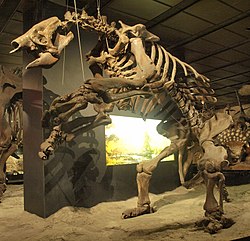
Metabolic skinflint or spendthrift? Insights into ground sloth integument and thermophysiology revealed by biophysical modeling and clumped isotope paleothermometry
Sign Up to like & getrecommendations! Published in 2025 at "Journal of Mammalian Evolution"
DOI: 10.1007/s10914-024-09743-2
Abstract: Remains of megatheres have been known since the 18th -century and were among the first megafaunal vertebrates to be studied. While several examples of preserved integument show a thick coverage of fur for smaller ground… read more here.
Keywords: ground sloth; clumped isotope; ground sloths; isotope paleothermometry ... See more keywords

Isotope data from amino acids indicate Darwin’s ground sloth was not an herbivore
Sign Up to like & getrecommendations! Published in 2021 at "Scientific Reports"
DOI: 10.1038/s41598-021-97996-9
Abstract: Fossil sloths are regarded as obligate herbivores for reasons including peculiarities of their craniodental morphology and that all living sloths feed exclusively on plants. We challenge this view based on isotopic analyses of nitrogen of… read more here.
Keywords: ground sloth; isotope data; amino acids; darwin ground ... See more keywords

Ground sloth vertebrae identification through multivariate analysis
Sign Up to like & getrecommendations! Published in 2019 at "Historical Biology"
DOI: 10.1080/08912963.2019.1700241
Abstract: ABSTRACT Extinct sloths (Xenarthra, Folivora) are morphologically diverse, despite some similarities among some Pleistocene genera. Cranial and diagnostic postcranial elements (especially limb bones) are taxonomically informative but the axial postcranial skeleton can prove difficult to… read more here.
Keywords: ground; ground sloth; position; identification multivariate ... See more keywords

Resolving the phylogenetic position of Darwin's extinct ground sloth (Mylodon darwinii) using mitogenomic and nuclear exon data
Sign Up to like & getrecommendations! Published in 2018 at "Proceedings of the Royal Society B: Biological Sciences"
DOI: 10.1098/rspb.2018.0214
Abstract: Mylodon darwinii is the extinct giant ground sloth named after Charles Darwin, who first collected its remains in South America. We have successfully obtained a high-quality mitochondrial genome at 99-fold coverage using an Illumina shotgun… read more here.
Keywords: darwinii; phylogenetic position; ground sloth; mylodon darwinii ... See more keywords