
Atypical Influenza A(H3N2) Activity Patterns in Germany, 2021–2023, and Characterization of Newly Emerged Virus Clades
Sign Up to like & getrecommendations! Published in 2025 at "Journal of Medical Virology"
DOI: 10.1002/jmv.70530
Abstract: The first waves of the COVID‐19 pandemic were accompanied by an unprecedented decrease of influenza activity which persisted throughout the 2020/21 and 2021/22 winter seasons. Here, we report on the unusual influenza circulation patterns that… read more here.
Keywords: atypical influenza; influenza; influenza h3n2; h3n2 ... See more keywords
Influenza vaccine effectiveness in preventing laboratory-confirmed influenza in outpatient settings: A test-negative case-control study in Beijing, China, 2016/17 season.
Sign Up to like & getrecommendations! Published in 2018 at "Vaccine"
DOI: 10.1016/j.vaccine.2018.07.077
Abstract: BACKGROUND The objective of this study was to estimate influenza vaccine effectiveness (VE) for the 2016/17 epidemic of co-circulating influenza A(H1N1)pdm09 and A(H3N2) viruses in Beijing, the capital of China. METHODS The surveillance-based study included… read more here.
Keywords: h3n2; influenza vaccine; influenza; study ... See more keywords
Development of adjuvant nanocarrier systems for seasonal influenza A (H3N2) vaccine based on Astragaloside VII and gum tragacanth (APS).
Sign Up to like & getrecommendations! Published in 2019 at "Vaccine"
DOI: 10.1016/j.vaccine.2019.05.038
Abstract: Adjuvants are chemical/biological substances that are used in vaccines to increase the immunogenicity of antigens. A few adjuvants have been developed for use in human vaccines because of their limitations including lack of efficacy, unacceptable… read more here.
Keywords: h3n2; astragaloside vii; seasonal influenza; influenza h3n2 ... See more keywords
Multiple amino acid substitutions involved in the virulence enhancement of an H3N2 avian influenza A virus isolated from wild waterfowl in mice.
Sign Up to like & getrecommendations! Published in 2017 at "Veterinary microbiology"
DOI: 10.1016/j.vetmic.2017.05.020
Abstract: Frequent emergence of low pathogenic avian influenza H3N2 viruses in the wild birds has caused concern for human health. Here, we generated mouse-adapted strains of a wild waterfowl-origin low pathogenic avian influenza H3N2 virus to… read more here.
Keywords: avian influenza; h3n2; virulence; influenza ... See more keywords
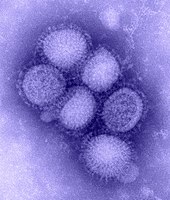
Pre-exposure with influenza A virus A/WSN/1933(H1N1) resulted in viral shedding reduction from pigs challenged with either swine H1N1 or H3N2 virus.
Sign Up to like & getrecommendations! Published in 2019 at "Veterinary microbiology"
DOI: 10.1016/j.vetmic.2018.11.008
Abstract: There is an urgent need to develop a broad-spectrum vaccine that can effectively prevent or eliminate the spread of co-circulating swine influenza virus strains in multiple lineages or subtypes. We describe here that pre-exposure with… read more here.
Keywords: h1n1; viral shedding; h3n2; swine h1n1 ... See more keywords
Protective effect of bivalent H1N1 and H3N2 VLP vaccines against Eurasian avian-like H1N1 and recent human-like H3N2 influenza viruses in a mouse model.
Sign Up to like & getrecommendations! Published in 2022 at "Veterinary microbiology"
DOI: 10.1016/j.vetmic.2022.109370
Abstract: Eurasian avian-like (EA) H1N1 swine influenza viruses (SIVs) are currently the most prevalent SIVs in Chinese swine populations, but recent human-like H3N2 SIV subtypes have also been frequently isolated. Hence, there is an urgent need… read more here.
Keywords: h1n1; like h3n2; vlp vaccines; h3n2 ... See more keywords
MicroRNA‐146a induction during influenza H3N2 virus infection targets and regulates TRAF6 levels in human nasal epithelial cells (hNECs)
Sign Up to like & getrecommendations! Published in 2017 at "Experimental Cell Research"
DOI: 10.1016/j.yexcr.2017.01.011
Abstract: ABSTRACT We have previously shown that human nasal epithelial cells (hNECs) are highly permissive cells for respiratory viruses including influenza A virus (IAV) and respiratory syncytial virus. Recent studies have indicated that microRNAs (miRNAs) are… read more here.
Keywords: h3n2; human nasal; infection; influenza ... See more keywords

Susceptibility of influenza A(H1N1)/pdm2009, seasonal A(H3N2) and B viruses to Oseltamivir in Guangdong, China between 2009 and 2014
Sign Up to like & getrecommendations! Published in 2017 at "Scientific Reports"
DOI: 10.1038/s41598-017-08282-6
Abstract: Nasopharyngeal swabs were collected from patients through the influenza surveillance network of the CDC of Guangdong. All specimens between 2009 and 2014 were checked for influenza virus using MDCK cells and further subtyped. Of those… read more here.
Keywords: h3n2 viruses; h3n2; 2009 2014; influenza h1n1 ... See more keywords
Synergistic PA and HA mutations confer mouse adaptation of a contemporary A/H3N2 influenza virus
Sign Up to like & getrecommendations! Published in 2019 at "Scientific Reports"
DOI: 10.1038/s41598-019-51877-4
Abstract: The mouse is the most widely used animal model for influenza virus research. However, the susceptibility of mice to seasonal influenza virus depends on the strain of mouse and on the strain of the influenza… read more here.
Keywords: h3n2; h3n2 influenza; influenza virus; virus ... See more keywords
Contemporary H3N2 influenza viruses have a glycosylation site that alters binding of antibodies elicited by egg-adapted vaccine strains
Sign Up to like & getrecommendations! Published in 2017 at "Proceedings of the National Academy of Sciences of the United States of America"
DOI: 10.1073/pnas.1712377114
Abstract: Significance The majority of influenza vaccine antigens are prepared in chicken eggs. Human vaccine strains grown in eggs often possess adaptive mutations that increase viral attachment to chicken cells. Most of these adaptive mutations are… read more here.
Keywords: glycosylation site; vaccine; h3n2; egg adapted ... See more keywords
Waning intra-season vaccine effectiveness against influenza A(H3N2) underlines the need for more durable protection
Sign Up to like & getrecommendations! Published in 2024 at "Expert Review of Vaccines"
DOI: 10.1080/14760584.2024.2331073
Abstract: ABSTRACT Background The question of whether influenza vaccine effectiveness (VE) wanes over the winter season is still open and some contradictory findings have been reported. This study investigated the possible decline in protection provided by… read more here.
Keywords: season; protection; influenza; influenza h3n2 ... See more keywords